
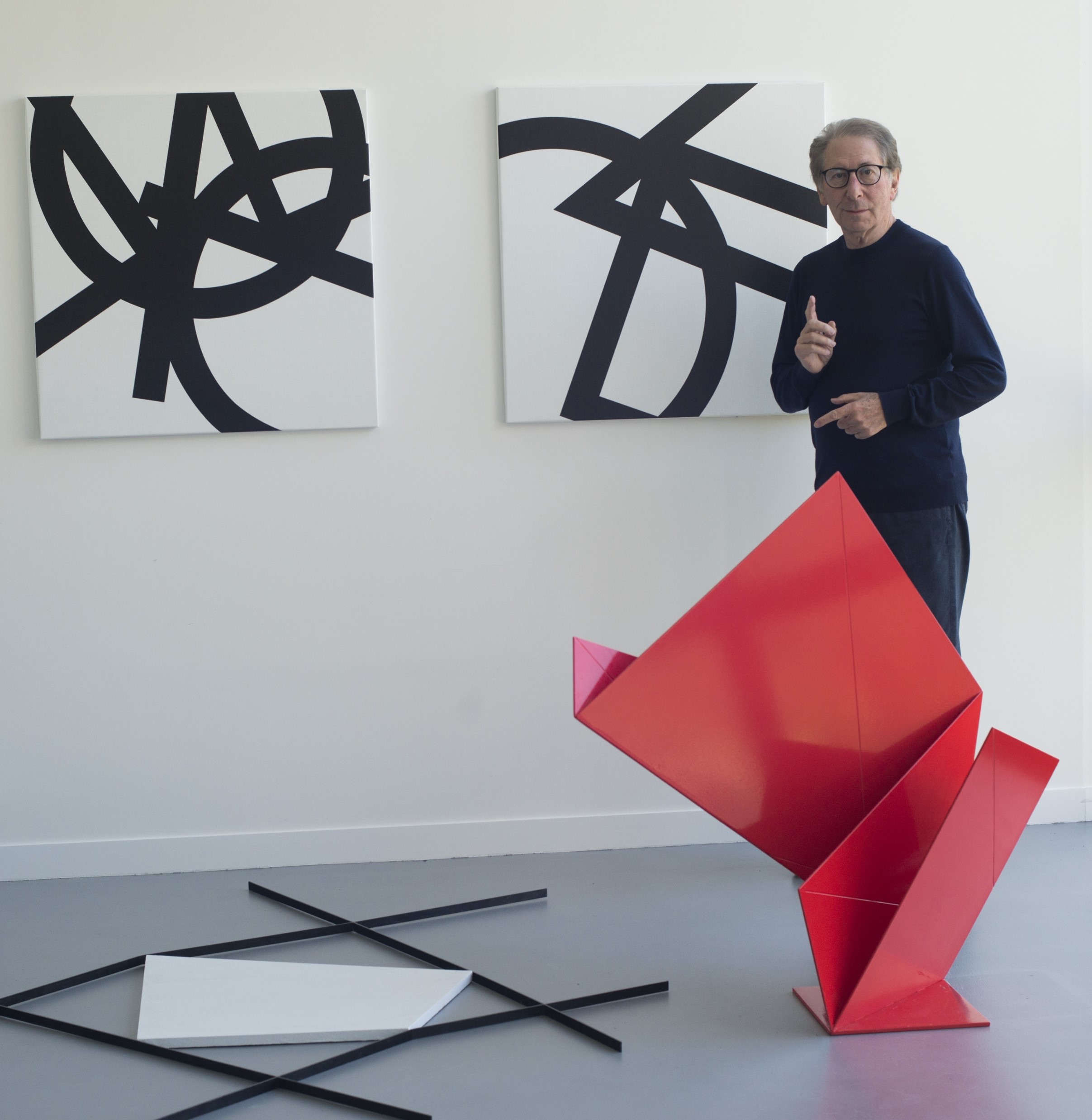
Beyond Constructivism
A century ago, Constructivism established a new paradigm for art: it had to focus on rational concepts and formalized rules, eliminate any aesthetic intention or decision of the artist, use industrial materials, simple geometric forms, few colors, align with modern life and technology… and support a political ideology… communism in Russia, where Constructivism was born after the October Revolution of 1917.
In Europe, the De Stijl movement founded by Theo Van Doesburg in the Netherlands (1917) and then the Bauhaus founded by Walter Gropius in Germany (1919) first developed this revolutionary transdisciplinary approach and produced artworks in many fields: painting, sculpture, photography, architecture, dance, and music. They also theorized about production processes as well as artist-viewer-market relationships.
Beyond the social and political constructivist utopia, this new vision of artistic creation spread worldwide and had, and still has, a major influence on the practice of concrete art: it gave rise to various artistic movements in which the fundamental principles of simplicity and rationalization are at work: systematism, minimalism, concrete art, geometric abstraction, conceptual art… to name but a few
In 1969, I met François Morellet, one of the major figures in geometric abstraction and a precursor of minimalism who opened up new creative directions beyond the barriers and constraints of constructivism while remaining true to its initial foundations. I was influenced by his vision and practice, in which the entire spirit of Dada, irony, humor, and derision combine with the rigor of systems and their rules.
